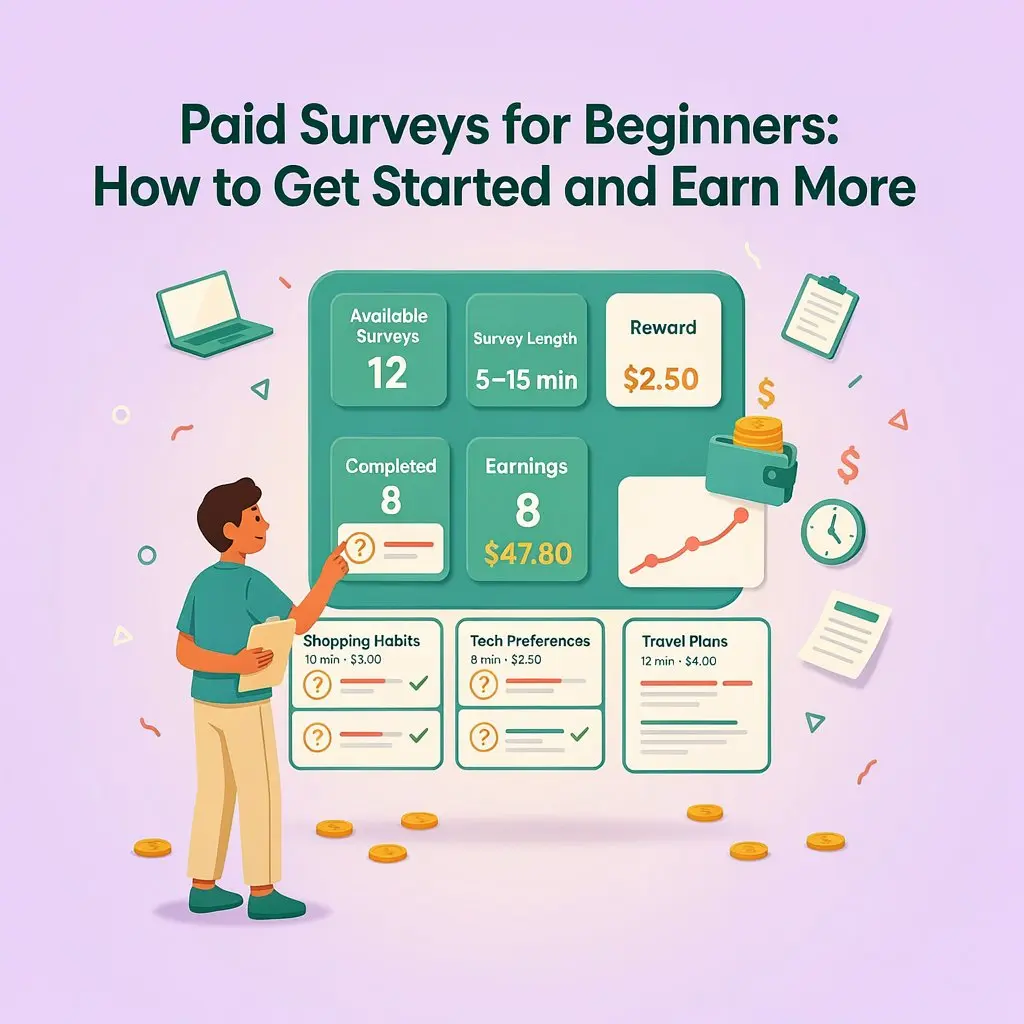
Paid surveys are one of the simplest ways to start making money online, especially if you are brand new to side hustles and do not want anything complicated. You do not need a degree, special training, expensive equipment, or a huge social media following. In most cases, all you need is a phone or computer, an internet connection, and a little patience.
The idea is simple: companies want to understand what real people think before they launch products, improve services, or shape their marketing. Instead of guessing what customers want, they pay survey platforms to collect opinions. Those platforms then share a small part of that money with users who complete surveys.
Now, let’s be clear from the start. Paid surveys will not make you rich. They are not a replacement for a full-time job, and anyone promising that you can earn hundreds of dollars a day from surveys alone is probably selling you a fantasy. But if you approach them the right way, paid surveys can be a useful beginner-friendly way to earn extra cash, gift cards, or PayPal money in your spare time.
The key is knowing which sites are worth your time, how to avoid scams, how to qualify for more surveys, and how to build a simple routine that helps you earn more without wasting hours clicking around.
In this beginner’s guide, we will walk through how paid surveys work, what you need to get started, how much you can realistically earn, and the smart habits that can help you make the most out of your time.
What Are Paid Online Surveys?
Paid online surveys are short questionnaires that companies use to collect opinions from everyday people. These surveys may ask about products you buy, apps you use, stores you shop at, your lifestyle, your spending habits, or your thoughts on a new idea before it becomes public.
For example, a company might want to know if people like a new snack flavor, what kind of ads grab attention, how often people shop online, or what features customers expect from a mobile app. Instead of guessing, they use survey platforms to hear directly from real users.
When you complete a survey, you are basically giving your opinion as a consumer. In return, the survey site rewards you with points, cash, gift cards, or other payout options depending on the platform.
Most paid surveys are simple. You read the question, choose your answer, and move to the next one. Some surveys may take only 2 or 3 minutes, while others can take 15 to 30 minutes. Longer surveys usually pay more, but that does not always mean they are worth your time.
The main thing beginners need to understand is this: paid surveys are not a business, and they are not a shortcut to easy wealth. They are a small online earning method. When used correctly, they can help you make extra money during your free time, especially while watching TV, waiting in line, taking a break, or sitting with your phone.
How Paid Survey Sites Work
Paid survey sites act as the middleman between companies and people who are willing to share their opinions. A company pays the survey platform to collect feedback, and the platform gives users a reward for completing surveys.
After you create an account, most survey sites will ask you to fill out a profile. This usually includes basic details like your age range, location, household size, shopping habits, employment status, and interests. This information helps the platform match you with surveys that fit your background.
For example, if a company wants feedback from people who shop online often, the survey site will look for users who match that profile. If another company wants opinions from parents, car owners, students, or people who use certain apps, the platform will send those surveys to the users who fit.
Once a survey becomes available, you can open it and answer a few screening questions. These questions help decide if you are the right match. If you qualify, you continue with the full survey and earn the reward after completing it. If you do not qualify, you may be redirected back to the dashboard without earning anything, or you may receive a small bonus depending on the platform.
Most survey sites pay in points first. Once you collect enough points, you can redeem them for PayPal cash, bank transfer, gift cards, prepaid cards, or other rewards. The exact payout options depend on the site.
The process is simple, but the trick is learning which surveys are worth your time. A survey that pays $0.25 for 20 minutes is not the same as one that pays $2 for 10 minutes. Beginners who understand this early can avoid wasting time and focus on the surveys that actually make sense.
Are Paid Surveys Legitimate?
Yes, paid surveys can be legitimate, but not every survey site is worth trusting. There are real companies that pay people for consumer feedback, and there are real users who earn extra cash or gift cards from survey platforms. The problem is that the survey space also attracts a lot of low-quality sites, fake promises, and scams aimed at beginners.
A legitimate paid survey site will be upfront about how rewards work. It will explain how much surveys pay, what the minimum cashout amount is, and which payout methods are available. It should also have clear terms, a privacy policy, and real user reviews outside of its own website.
The red flag is when a site makes the opportunity sound too good to be true. If a platform claims you can make $500 a day answering basic surveys, be careful. Paid surveys are simple, but they are not magic. Most surveys pay small amounts because companies are paying for opinions, not hiring you for a full-time role.
You should also avoid any survey site that asks you to pay a fee before you can start earning. Real survey platforms do not need you to buy access to surveys. If a site says you must pay for a “premium survey list” or “activation fee,” that is usually a sign to walk away.
The safest way to start is to use well-known survey platforms, test them slowly, and never share sensitive information like your banking login, full Social Security number, passport details, or private passwords. Your opinion has value, but protecting your information matters even more.
How Much Can Beginners Earn From Paid Surveys?
Beginners should expect paid surveys to be a small extra income source, not a main income stream. Most people will not earn enough from surveys to replace a job, pay all their bills, or build a serious online business. But if you use the right platforms and stay consistent, surveys can help you make a little extra money during your free time.
A realistic beginner might earn anywhere from a few dollars per week to $25, $50, or more per month, depending on their country, profile, available surveys, and how much time they put in. Some users may earn more if they qualify for higher-paying surveys, product tests, focus groups, or special research panels.
Your location plays a big role. Survey platforms usually have more opportunities for users in countries like the United States, Canada, the United Kingdom, and Australia. If you live outside those regions, you may still find surveys, but the number of available options can be lower.
Your profile also matters. Companies often look for specific groups of people, such as parents, students, homeowners, online shoppers, workers in certain industries, or people who use specific products. That is why two people can join the same survey site and have completely different earning results.
The best way to think about paid surveys is simple: they are pocket money. They can help with small expenses, gift cards, subscriptions, coffee money, or extra savings. The people who enjoy surveys the most are usually the ones who keep their expectations realistic and treat it as a casual side activity instead of a big payday.
What You Need Before Starting
One of the best things about paid surveys is that you do not need much to get started. You do not need a fancy setup, a big investment, or previous online earning experience. Most beginners can start with the tools they already have.
At the basic level, you need a phone, tablet, or computer with internet access. Many survey platforms work directly from a web browser, while others have mobile apps that make it easier to answer surveys on the go. If you plan to take surveys often, using both a phone and a computer can help because some surveys are easier to complete on a larger screen.
You should also create a separate email address just for survey sites. This helps keep your main inbox clean and makes it easier to track survey invitations, payout updates, and account messages. Survey platforms can send a lot of emails, so having a dedicated inbox keeps everything organized.
A PayPal account can also be useful because many survey sites offer PayPal as a cashout option. Some platforms may offer gift cards instead, such as Amazon, Walmart, Visa prepaid cards, or other store cards. Before joining a site, always check if the payout method works in your country.
You may also need a little patience. Surveys are simple, but you will not qualify for every one. Some days you may find several good surveys, and other days you may barely find anything worth completing. That is normal.
The goal is to set yourself up properly from the beginning so the process feels smooth, organized, and low-stress.
How to Choose Legitimate Paid Survey Sites
Choosing the right survey sites is one of the most important steps for beginners. A good platform can make the process simple and rewarding, while a bad one can waste your time, flood your inbox, or make it hard to cash out.
Start by looking for survey sites with a real track record. Check how long the platform has been around, what users are saying on review sites, and whether people are actually receiving payments. A few negative reviews are normal, but if you keep seeing complaints about missing rewards, locked accounts, or impossible cashouts, that is a warning sign.
Next, check the payout options before signing up. Some platforms pay through PayPal, while others offer gift cards, prepaid cards, bank transfers, or points that can be redeemed later. Make sure the payout method works for you and your country. There is no point spending time on a survey site if you cannot actually receive the money.
You should also pay attention to the minimum cashout amount. A site with a $5 or $10 minimum payout is usually easier for beginners than one that makes you reach $50 before you can withdraw. Lower cashout limits let you test the platform faster and see if it is worth using long-term.
Another thing to check is how clear the platform is about rewards. A good survey site should show how much a survey pays and how long it may take before you start. If everything feels hidden, confusing, or misleading, be careful.
The best approach is to start with two or three trusted platforms, test them for a week, and track how much you earn compared to the time you spend. If a site gives you consistent surveys and actually pays, keep it. If it keeps wasting your time, move on.
How to Sign Up for Your First Survey Platform
Signing up for your first survey platform is usually quick, but it is worth doing carefully. The information you enter can affect which surveys you receive, how often you qualify, and whether your account stays in good standing.
Start by choosing one legitimate survey site to test first. You do not need to sign up for ten platforms on day one. Pick one that has good reviews, a payout method you can use, and a low minimum cashout amount. Once you understand how the process works, you can add more platforms later.
When creating your account, use your real information. Survey sites use your profile to match you with research opportunities, so entering fake details can lead to disqualifications, missing rewards, or account problems. If the platform asks for your age range, location, shopping habits, or household details, answer honestly.
After signing up, confirm your email address right away. This helps activate your account and makes sure you receive survey invitations, payment updates, and important notices. If you created a separate email address for surveys, check it regularly so you do not miss time-sensitive opportunities.
Next, complete your profile as much as possible. Many beginners skip this step, but it can make a big difference. A complete profile gives the platform more information about you, which can help match you with surveys that fit your background.
Before taking your first survey, look around the dashboard. Check where surveys appear, how rewards are shown, what the cashout rules are, and where your account settings are located. Once you understand the layout, the process becomes much easier.
Your first goal should not be to earn a lot immediately. Your first goal is to learn how the platform works, complete a few surveys, and see if it is actually worth your time.
Why Your Survey Profile Matters
Your survey profile is one of the most important parts of earning with paid surveys. It tells the platform who you are, what kind of consumer you are, and which surveys you may be a good fit for.
When companies pay for survey responses, they are usually looking for feedback from specific groups of people. They may want opinions from parents, students, full-time workers, online shoppers, homeowners, renters, gamers, travelers, or people who use certain brands. Your profile helps the survey site decide whether you match those requirements.
This is why completing your profile fully can help. If your account only has basic information, the platform has less to work with. But if your profile includes your interests, shopping habits, employment status, household details, and product preferences, you may be matched with more relevant surveys.
It is also important to keep your profile accurate. Do not try to game the system by giving fake answers just to qualify for more surveys. Survey platforms often check for consistency. If your profile says one thing but your survey answers say another, your account may be flagged or your rewards may be delayed.
Your profile should also be updated when something changes. If you move, start a new job, change your household situation, buy a car, have a child, start school, or pick up new hobbies, those details can affect which surveys you qualify for.
Think of your survey profile like your earning filter. The better and more accurate it is, the easier it becomes for platforms to send you surveys that actually fit you.
Why You Keep Getting Disqualified From Surveys
Survey disqualification is one of the most frustrating parts of using paid survey sites, especially when you are just getting started. You may click on a survey, answer a few questions, and then suddenly get told you are not a match. It can feel like you did something wrong, but most of the time, that is just how survey platforms work.
Companies usually need feedback from a specific type of person. A survey may only be looking for parents with young children, people who own a car, users of a certain app, shoppers from a certain country, or people within a certain income range. If your answers do not match what the company needs, the survey ends early.
Sometimes you may also get disqualified because the survey has already received enough responses from people like you. For example, if the company only needs 500 responses from your age group or location, the survey may close once that limit is reached.
Another common reason is inconsistent answers. Survey platforms pay attention to whether your responses make sense. If your profile says you are a student, but later you answer that you work full-time in a completely different field, the system may flag that. This is why honesty matters. Trying to force your way into more surveys can actually make you qualify for fewer over time.
Speed can also be a problem. If you rush through questions too quickly, the platform may think you are not paying attention. Some surveys include attention-check questions to make sure you are reading carefully.
Disqualifications are normal, but they should not happen every single time. If one platform constantly screens you out, test another one. The goal is to find sites that match your profile better and give you more surveys that are actually worth completing.
How to Qualify for More Surveys
If you want to qualify for more paid surveys, the first rule is to keep your profile complete and accurate. Survey platforms use your profile to match you with opportunities, so the more information they have, the better chance you have of seeing surveys that actually fit you.
Take time to answer profile questions honestly. Add details about your interests, shopping habits, household, work situation, education, technology use, and lifestyle when the platform asks for them. These details may seem small, but they can help the site understand which surveys to send your way.
Another helpful habit is checking your survey dashboard regularly. Some surveys fill up quickly, especially the ones that pay better. If you only log in once in a while, you may miss good opportunities before they close. You do not need to sit on the site all day, but checking once or twice a day can make a difference.
You should also read each question carefully. Some surveys include attention checks to make sure you are not clicking random answers. If you rush, give confusing responses, or contradict yourself, you may get disqualified or flagged by the platform.
It also helps to be consistent. Your answers should line up with the information in your profile. If your situation changes, update your profile instead of giving different answers from survey to survey.
Finally, try more than one legitimate platform. Not every survey site will be a good match for your location or profile. Testing two or three trusted sites gives you more chances to find surveys that fit you, which can lead to fewer disqualifications and better earning potential.
How to Earn More With Paid Surveys
If you want to earn more with paid surveys, you need to be a little strategic. The people who get the best results are not always spending the most time. They are usually the ones who know which surveys to take, which ones to skip, and which platforms are actually worth using.
Start by focusing on surveys that pay fairly for the time required. A $1 survey that takes 5 minutes is usually better than a $2 survey that takes 30 minutes. Before starting, check the estimated time and reward. If the pay is too low for the effort, skip it and look for something better.
You should also use more than one survey platform. One site may have slow days, while another may have several surveys available. Having two or three reliable platforms gives you more options and helps you avoid depending on one dashboard.
Another way to earn more is to look for bonus opportunities. Some survey sites offer daily polls, sign-up bonuses, streak rewards, referral bonuses, product testing, paid offers, or focus groups. These can sometimes pay better than regular surveys, but you should still read the details before completing them.
Set a simple routine instead of checking randomly all day. For example, you could spend 15 to 30 minutes in the morning or evening checking your best platforms. This keeps surveys from eating up your whole day while still giving you a chance to catch fresh opportunities.
Finally, track your results. Write down which sites pay you, how long it takes to reach cashout, and which platforms waste your time. After a week or two, you will start to see which sites are worth keeping and which ones should be dropped.
Paid surveys are not about working harder forever. They are about finding the small pockets of time where your opinions can turn into a little extra money.
How to Know If a Survey Is Worth Your Time
Not every survey is worth taking. Some surveys pay fairly, while others take too long for a tiny reward. If you want to earn more without feeling frustrated, you need to learn how to judge a survey before you start.
The easiest way is to compare the reward with the estimated time. For example, a survey that pays $1 for 5 minutes is usually a better choice than a survey that pays $1.50 for 25 minutes. Even though the second survey pays more, it takes much longer.
A simple rule is to ask yourself: “Would I still feel okay doing this if I got disqualified halfway through?” If the answer is no, you may want to skip it. Some surveys start with several screening questions before you know if you qualify, so your time matters.
You should also pay attention to surveys that ask too much for too little. If a survey is long, repetitive, confusing, or filled with endless product questions for a tiny reward, it may not be worth finishing unless you are very close to cashing out.
Another thing to consider is the payout threshold. If you are only a few points away from reaching your minimum cashout, a lower-paying survey might still make sense. But if you are starting from zero, you should be more selective.
Over time, you will start to recognize which surveys are worth clicking. The goal is not to accept every survey you see. The goal is to protect your time, choose better opportunities, and avoid turning a simple side hustle into a headache.
A Simple Paid Survey Routine for Beginners
The easiest way to stay consistent with paid surveys is to create a simple routine. You do not need to spend hours every day refreshing survey dashboards. In fact, doing that can make the whole thing feel boring and frustrating fast.
Start with 15 to 30 minutes per day. That is enough time to check your main survey platforms, complete a few short surveys, and see if anything better is available. If there are no good surveys, log out and come back later. Do not force it.
A good beginner routine could look like this: check your survey email, open your top two or three platforms, complete any profile updates, look for the highest-paying surveys first, and skip anything that feels too long for the reward.
It can also help to choose a specific time of day. Some people check surveys in the morning before work, during a lunch break, or at night while watching TV. The best time is the one that fits naturally into your life without making surveys feel like another stressful job.
Once a week, review your results. Look at how much you earned, which platforms gave you the best surveys, and which ones wasted your time. If one site keeps disqualifying you or offering poor rewards, replace it with another platform.
The goal is to keep the routine light, simple, and realistic. Paid surveys work best when they fit into your spare time instead of taking over your day.
Common Mistakes Beginners Make With Paid Surveys
A lot of beginners get frustrated with paid surveys because they start with the wrong expectations or use the wrong strategy. The mistakes are easy to make, but they are also easy to avoid once you know what to watch for.
One of the biggest mistakes is expecting surveys to replace a real income. Paid surveys can help you earn extra cash, but they are not designed to make you rich. If you go in expecting big money, you may feel disappointed quickly. It is better to treat surveys as small side money that can add up over time.
Another mistake is signing up for too many platforms at once. It may seem smart to join every site you find, but that can get messy fast. Your inbox fills up, you forget which sites are worth using, and you end up wasting time on low-quality platforms. Start with a few trusted sites, then add more if needed.
Some beginners also skip their profile questions. This can hurt your chances of qualifying for surveys because the platform does not have enough information to match you properly. Completing your profile may feel boring, but it can help you get better opportunities.
Rushing through surveys is another common problem. If you answer too quickly, give random responses, or miss attention-check questions, your account may get flagged. Survey platforms want thoughtful answers, not careless clicks.
The biggest mistake of all is staying on a platform that clearly is not working for you. If a site keeps disqualifying you, pays too little, or makes cashing out difficult, do not keep forcing it. Your time is still valuable, even when you are trying to earn small money online.
How to Spot a Paid Survey Scam
Paid survey scams usually target beginners by making the opportunity sound bigger and easier than it really is. They know people are looking for simple ways to make money online, so they use bold promises to get attention.
The first red flag is any site that asks you to pay before you can earn. Legitimate survey platforms are free to join. You should not have to buy access, pay an activation fee, or purchase a “secret list” of high-paying surveys. If the site wants money upfront, be careful.
Another warning sign is unrealistic income claims. If a platform says you can make hundreds of dollars per day just by answering basic questions, that is not realistic. Paid surveys are small earning opportunities. They can be useful, but they are not a shortcut to wealth.
You should also be cautious with sites that ask for sensitive personal information too early. A normal survey site may ask about your age range, location, interests, and shopping habits. But it should not ask for your bank password, private account logins, full identity documents, or anything that feels unnecessary for a simple survey.
Poor website quality can also be a clue. If the site has broken pages, no clear contact information, no privacy policy, confusing payout rules, or lots of exaggerated claims, slow down before signing up.
Before using a new survey platform, search for real reviews. Look for payment proof, complaints, payout issues, and user experiences from different sources. A few complaints are normal, but repeated warnings about unpaid rewards or locked accounts should not be ignored.
A good rule is simple: if the site makes you feel rushed, pressured, or overly excited with huge promises, step back. Real paid surveys are simple and modest. Scams are usually the ones trying to make them sound like a jackpot.
How to Protect Your Privacy When Taking Surveys
Paid surveys are based on personal opinions, but that does not mean you should share everything. A legitimate survey platform may ask about your age range, location, shopping habits, job type, household size, or products you use. That kind of information helps match you with surveys. But you should still be careful about what you give away.
Start by using a separate email address for survey sites. This keeps your main inbox clean and helps protect your personal or business email from too many promotional messages. It also makes it easier to track survey invites and payout updates in one place.
You should also avoid sharing sensitive information that is not necessary. A survey site should not need your banking password, private login details, full identity documents, or account recovery codes. If a survey asks for something that feels too personal or unrelated, close it and move on.
Before signing up for a platform, check its privacy policy. You do not need to read every line like a lawyer, but you should understand how your data may be used, whether it can be shared with partners, and how you can delete your account if needed.
Be careful with survey links from random emails, social media comments, or messages promising huge rewards. It is safer to log in directly through the official survey website or app instead of clicking unknown links.
You can also limit how much you reveal in open-ended answers. Share useful opinions, but avoid writing private details like your full address, workplace secrets, personal account information, or anything you would not want stored by a third-party company.
Paid surveys can be simple and safe when you use common sense. Give honest feedback, protect your private information, and remember that a small reward is never worth risking your identity or personal data.
Paid Surveys vs Other Online Side Hustles
Paid surveys are one of the easiest online side hustles to start, but they are not the most profitable. That is why it helps to understand where surveys fit compared to other ways of making money online.
The biggest advantage of paid surveys is simplicity. You do not need to create content, talk to clients, learn a complicated skill, or build an audience. You can sign up, answer questions, and start earning small rewards in your spare time. For beginners, that low barrier makes surveys less intimidating than many other side hustles.
But the trade-off is limited earning potential. Surveys usually pay small amounts because the work is simple and widely available. You are not building a long-term asset, gaining a high-income skill, or creating something that can keep earning later. You are trading a little time for a little money.
Other side hustles, like freelance writing, virtual assistance, blogging, affiliate marketing, selling digital products, or remote customer support, may take more effort to learn. But they can also lead to higher income over time. They may help you build skills, attract clients, or create income streams that grow beyond a few dollars per task.
That does not mean paid surveys are useless. They can be a good starting point if you are nervous about making money online, need something flexible, or want a simple way to earn your first few dollars from home.
The best way to see surveys is as a beginner step, not the final destination. They can help you get comfortable with online earning, but once you want more serious income, it may be worth exploring side hustles with better long-term potential.
When to Stop Using a Survey Platform
Not every survey platform deserves your time forever. Some sites may seem promising at first, but after a few days or weeks, you may realize they are not giving you enough value. Knowing when to stop using a platform is just as important as knowing which one to start with.
One clear sign is constant disqualification. Getting screened out sometimes is normal, but if almost every survey ends before you can complete it, the platform may not be a good match for your profile or location.
Another sign is poor pay for the time required. If most surveys take 20 minutes and only pay a few cents, you are probably better off using a different site. Small earnings are expected with surveys, but your time should still be respected.
You should also be careful with platforms that make cashing out difficult. If the minimum payout is too high, rewards take too long to process, or users often complain about missing payments, that is a reason to move on.
A messy user experience can also be a warning sign. If the site constantly redirects you, shows broken surveys, freezes often, or sends you through endless screening questions with no reward, it can quickly become more frustrating than useful.
The best approach is to review your survey platforms every week or two. Ask yourself: Did this site give me real opportunities? Did I earn anything? Was the time worth it? Did the platform feel trustworthy?
If the answer is no, stop using it and test another option. Paid surveys should feel like a simple way to earn a little extra money, not like a daily battle for pennies.
Frequently Asked Questions About Paid Surveys
Can you really make money with paid surveys?
Yes, you can make money with paid surveys, but the earnings are usually small. Most people use surveys to earn extra cash, gift cards, or PayPal money in their spare time. They are best for pocket money, not full-time income.
Are paid survey sites free to join?
Most legitimate paid survey sites are free to join. You should be careful with any platform that asks you to pay before you can start earning. Real survey sites usually make money from companies that need research, not from charging beginners upfront fees.
How long does it take to complete a survey?
Some surveys take only a few minutes, while others may take 15 to 30 minutes or more. Before starting, check the estimated time and reward so you can decide if the survey is worth completing.
Why do I get disqualified from surveys?
You may get disqualified because you do not match the audience the company is looking for. A survey may need people from a specific country, age group, income level, shopping habit, or lifestyle. Disqualification is normal, but if it happens constantly, that platform may not be a good fit for you.
What is the best payout method for paid surveys?
PayPal is one of the most popular payout methods because it gives you cash instead of store credit. Gift cards can also be useful if they are for stores you already use. The best payout method depends on what is available in your country and what you personally prefer.
How many survey sites should beginners use?
Beginners should start with two or three trusted survey platforms. This gives you more opportunities without overwhelming your inbox or making the process confusing. Once you know which sites work best for you, you can add more if needed.
Can paid surveys replace my job?
No, paid surveys should not be viewed as a job replacement. They are a simple way to earn small rewards in your spare time. If you want serious online income, you may eventually want to explore higher-paying side hustles like freelancing, remote work, affiliate marketing, or digital products.
Are paid surveys safe?
Paid surveys can be safe if you use legitimate platforms and protect your personal information. Avoid sites that ask for private passwords, banking logins, full identity documents, or upfront payments. Always read the platform’s payout rules and privacy policy before spending too much time on it.
Final Thoughts
Paid surveys are not the flashiest side hustle, and they are definitely not the highest-paying one. But for beginners, they can be a simple way to take the first step into earning money online without needing advanced skills, upfront investment, or a complicated setup.
The most important thing is to keep your expectations realistic. You are not going to get rich from answering surveys, but you can earn small rewards that help with everyday expenses, gift cards, subscriptions, or savings. That alone can make surveys worth trying, especially if you use them during time that would have been wasted anyway.
The key is to choose legitimate platforms, complete your profile honestly, avoid scams, protect your personal information, and pay attention to which surveys are actually worth your time. Once you learn how the process works, it becomes much easier to spot good opportunities and skip the ones that drain your time.
Paid surveys work best when you treat them as a light side hustle, not a full-time income plan. Start small, test a few trusted platforms, track your results, and keep only the sites that actually pay and feel worth using.
If you are brand new to making money online, paid surveys can be a good first step. They will not change your life overnight, but they can help you build confidence, earn your first few dollars online, and open the door to bigger side hustles later.

Leave a comment
Your email address will not be published. Required fields are marked *